Author: Emily Howard

Finding the Right Candidates
Hiring can feel like one of the hardest parts of running a small business. You're looking for someone reliable, someone who genuinely cares, someone who fits your culture, and ideally someone who can jump in and start making a difference —often on day one, out in the field, in front of clients. But with limited time and resources, it's easy for the process to become overwhelming. The good news is that hiring doesn't have to feel like a chore. With a few thoughtful shifts, you can make it simpler, more human, and much more effective.Create a PlanOne of the best places to start is by getting clear about what you need. Before posting a job, take a moment to think about the role at its core. What tasks absolutely need to get done? What type of person thrives in your environment? And which skills are truly essential from day one? When you strip away the clutter and focus on what really matters, you end up with a job description that attracts people who are genuinely excited about the work, not just scrolling through endless listings. Finding CandidatesOne powerful advantage small businesses have is their personality. People want to feel good about where they work, and your culture is one of the best tools you have. Don't be afraid to share your story, your values, and the little things that make your workplace special. When candidates get a sense of who you are and what you care about, the right people naturally gravitate toward you.Your network can also be a surprisingly strong hiring tool. Many business owners find their best employees through people they already know, whether that's crew members, regular clients, general contractors and other partners you work alongside, or even friends. Simply mentioning that you're hiring or posting the news on your personal and business social channels can lead to candidates who already understand your world and may be a great cultural fit. The InterviewWhen you start meeting candidates, try to look beyond the resume. Experience matters, of course, but in a small, hands-on workplace, things like attitude, flexibility, and problem-solving often matter more. Consider adding a small task, a real-life scenario, or even a short working interview to the process. These give you a clearer picture of how someone shows up—how they communicate, how they handle a curveball, and how they'd represent your business on someone else's property.As you evaluate people, focus on qualities that are especially valuable in a small business environment—things like curiosity, kindness, reliability, and a willingness to pitch in wherever needed. You can teach someone your systems, your processes, and the finer points of the trade. You can't teach them to care.Keeping your interview process simple goes a long way. Good candidates don't want or need a long, drawn-out experience. A quick intro call, a conversational interview, a short assessment, and a timely decision are often more than enough. Being organized and responsive not only shows respect for a candidate's time but also reflects well on your business—especially when word travels fast within a tight-knit local trade. A Smooth TransitionIt's also worth thinking past the hire itself and toward how someone gets up to speed once they're in. A clear first week—pairing a new team member with someone experienced, walking through expectations around safety, quality, and professionalism on-site, and giving early feedback rather than waiting for a review—sets the tone for everything that follows. Small businesses often can't afford a long ramp-up period, so a thoughtful onboarding process, even a simple one, helps new hires feel confident faster and reduces the chance of early missteps that can affect a client relationship. RetentionDon't underestimate retention as part of the hiring equation, either. Every time a good employee leaves, you're back at square one, spending time and money to fill the gap while existing crews absorb the extra load. Simple things—clear schedules, fair pay, recognition for a job well done, and a sense that there's room to grow—go a long way toward keeping the people you worked hard to find. In a business built on reputation and repeat clients, consistency in who shows up matters just as much as the quality of the work itself.And finally, remember that hiring is a two-way street. Candidates aren't just trying to impress you; they're also trying to figure out whether you're the right fit for them. Be honest about what the job is like day-to-day, what makes it rewarding, and where the growth opportunities really exist. Transparency builds trust, and trust helps you attract people who want to stay.Hiring doesn't have to feel intimidating. When you approach it with clarity and authenticity, the right people become much easier to find. And once you bring those people into your business, they can truly transform it.Chatfield Global is the Preferred HR Partner of the CPIA. To learn more about the complimentary and discounted services offered to CPIA members, click here.

Speakers Give a Sneak Peek At Their Sessions
Before we head to Nashville, here is a little peek behind the curtain for our sessions on AI, Elite Teams, and Creating a 12-Month Action Plan that will take your business to the next level.Beyond Good: What It Takes to Go From Great to EliteThe CPIA is excited to announce that Navy SEAL combat veteran, entrepreneur, and executive leader Eric Frohardt will tackle creating elite teams and being elite team members at the 2026 CPIA Leadership Conference in his keynote session.Frohardt shares his perspective on Elite Teams after serving nearly 12 years on active duty in the U.S. Navy, including service with the highly revered Naval Special Warfare Development Group (DEVGRU), also known as SEAL Team 6. Workshop - Building Your AI RoadmapWhy should you attend our AI workshop? Susan Frew is here to tell you about how how AI is making changes to running a commercial painting business—right now. After her session, you'll understand how AI fits into your business, and you'll walk away with two to three things you can put to work next week.Don't miss this opportunity to get to know the tech so you can get to know where it’s going and what it can do for you. From Ideas to Execution: Your 12-Month Action Plan Ever go to a conference, get a ton of great ideas, and then store them in a drawer or on your computer?We are about to change that habit! Join Brian Nolan from Nolan Consulting Group, Inc. at the 2026 CPIA Leadership Conference in a session designed to put those ideas to work. You’ll learn how to define what winning looks like, use your team to move the needle on these ideas, and create a pathway to execution. Time is running out. Register today!
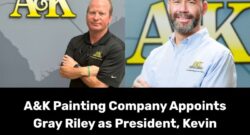
A&K Painting Company Appoints Gray Riley as President, Kevin Robbins Transitions to CEO
A&K Painting Company, a full-service commercial and industrial painting contractor headquartered in Charlotte, NC, recently announced key leadership appointments to support its continued growth across the East Coast. Industry veteran Gray Riley has been named president, taking charge of total business execution. Riley, who recently celebrated 15 years with the company, has been instrumental in shaping A&K’s operational foundation and customer partnerships. In his new role, he oversees sales, business development, client experience, marketing, operations, project management, and financial performance. Concurrently, Kevin Robbins will step into the role of chief executive officer. As CEO, Robbins will shift his focus toward long-term strategic vision, expansion into new regional markets, and establishing scalable systems to guide the contractor through its next decade of growth. To learn more about A&K Painting Company, visit akpainting.com/.

CPIA Spotlights Contractors in the 2026 Leadership Conference Education Sessions
Your peers tackle many of the same challenges you do.That’s why lessons and stories from commercial painting contractors are central to our educational curriculum. In September, attendees will enjoy a range of panel discussions focused not just on challenges and successes, but on the solutions painting contractors are using today.Understanding that success can be attained from many different paths, these panels allow attendees to see perspectives, experiences, and strategies from industry peers.Join us as contractors with real-world experience discuss topics from business development to productivity; from accountability to AI.Business Development Panel DiscussionAlec Kinard, Grydaze; Cameron Steindl, Higgins; Sean Gillespie, Harrison Contracting; and Gray Riley, President A&K Painting will come together for a discussion focused on how they find opportunities, build relationships, and better position their companies for future work.Growing Your Business Organically Panel DiscussionGrowing a commercial painting company doesn’t always have to rely on more marketing and more local customers. The contractors of today are utilizing a host of strategies, including more services and expanding geographical territories, to build and scale their businesses.In this panel, Aaron Moore, PPD; Chris Neeson, Inline Painting; and Matt Fackrell, Accent Painting will share their perspectives during the Growing Your Business Organically panel discussion.Driving Productivity & AccountabilityIt’s not as simple as asking people to work harder. Productivity depends greatly on how owners create systems, expectations, and accountability, as well as how they communicate those things that allows teams to perform consistently.Bill Curtindale, Pro Paint Solutions, and Louie Boncyk, Benise-Dowling will be among the contractors discussing productivity and accountability within their organizations.AI in Action Panel DiscussionAI is being adopted at different rates and for different purposes across our industry. As this cutting-edge technology evolves, we seek to understand the real-life use cases that are proving to be effective or ineffective in our peers’ businesses. John Ross, Cherry Coatings; Phil Hursh, Hursh Painting; Kevin Robbins, A&K Painting; and Jason Fike, Service Contractor Solutions will take the stage for AI in Action, a panel discussion focused on AI within the painting industry.An AI Implementation StoryIn a deep dive on implementation and adoption, Jann Maxwell of Magnum will present An AI Implementation Story.While panel discussions offer a range of perspectives, Maxwell's session will provide an opportunity to hear one company's implementation story and the lessons that came with putting AI into practice.Join us September 27-30 as we learn not just from experts but from the experience of peers who face the same challenges we do.
Picking the Right HR Partner
Every growing organization eventually hits the same wall—HR can no longer run on good intentions and a shared spreadsheet. The question isn't whether to invest in HR support, but which kind, and when. With options ranging from PEOs and EORs, to consultants and fractional leaders, the landscape can feel more confusing than reassuring. The right choice isn't one-size-fits-all. It depends on your size, your stage of growth, your objectives, and the culture you're trying to build and protect.A Range of OptionsAt the most basic level, administrative models such as PEOs (Professional Employer Organizations), EORs (Employers of Record), and ASOs (Administrative Services Organizations) exist to lift compliance and paperwork burdens. A PEO becomes a co-employer, handling payroll, benefits, and tax filings while you retain day-to-day supervision of your team. An EOR lets you hire legally in a state or country where you do not have an entity. An ASO offers similar administrative lift without co-employment, so you stay the legal employer and keep more control over your benefits plan. Alongside these administrative models sit specialist providers such as payroll processors, benefits brokers, and staffing and recruiting agencies, each focused on addressing one small piece of an organization’s needs. Then there's the strategic tier. In-house HR is appropriate when an organization has enough volume and complexity to justify a full-time hire, but may not deliver across all HR functions. HR consultants are best for defined, project-based work, with many specializing in a specific HR discipline. Managed/outsourced HR services handle operational services (e.g., handbooks, policies, HRIS administration, performance management, and compensation-cycle support) but do not act as an embedded advisor. Fractional HR partnership draws on the best of all the strategic tier options, bringing broad expertise, project support, operational HR support, and strategic partnership. A PEO can be a good answer, especially for smaller organizations typically under 40 employees that do not have the internal capacity to manage payroll, benefits, and compliance themselves. Because a PEO pools employees across many client companies, it can negotiate health insurance, retirement plans, and other benefits at a scale and price point that a small company could never reach on its own—the kind of coverage employees expect from a much larger employer. That same pooling effect also shifts a meaningful share of compliance and employment-law risk off an owner’s plate, spreading exposure across a larger base and absorbing the administrative burden of multi-state payroll tax and filing requirements. It's fast, it's proven, and for a company still building its internal capacity, it removes real risk while gaining credibility with employees. But a PEO, by design, is a transaction. A PEO doesn't know your culture, your people, or the nuance behind why one team is struggling while another thrives. And it isn't built to weigh in on the harder judgment calls: how to structure a new role, whether a manager is ready for more responsibility, or how to handle a sensitive employee relations issue without damaging trust. The Role of a Fractional HR PartnerThat's where a relationship-driven consulting partnership earns its place. A fractional HR partner takes the time to understand how your organization operates. A fractional HR partner learns a company’s history, its unwritten rules, its people. That familiarity shows up in concrete ways when designing compensation and performance frameworks that actually fit the business; clarifying reporting lines and decision rights before growth makes the ambiguity expensive; coaching managers through their first hard conversations; and guiding leadership through sensitive moments like a reduction in force, a leadership transition, or a workplace investigation with far less risk of a costly misstep. Rather than imposing a generic playbook, that familiarity transforms talent into the strategic advantage it should be, informing structure, culture, and growth decisions, not just administratively processing them. An Integrated Management ApproachMost organizations do best with a blend of administrative infrastructure handling the transactional load paired with a relationship-driven partner who brings strategic judgment, discretion, and continuity as the business evolves. A growing company could pair a PEO with a fractional HR leader who manages that PEO relationship, freeing the CEO or CFO from day-to-day oversight, while still getting senior-level guidance on the harder questions of structure, culture, and leadership development. The right mix changes as you grow, and that's precisely the point. Choosing an HR partner is about finding the right level of support, at the right time, from people who genuinely know your business. That's the model Chatfield Global has practiced for thirty years—loyal partnership, intentional growth, limitless flexibility, and insightful experience—all firmly focused on helping clients get the most out of their most important asset, their human capital. About the AuthorKatie Spilotro is the director of organizational effectiveness at Chatfield Global LLC. For more than thirty years, Chatfield Global LLC, a second-generation, women-owned family business, has operated under the belief that people are an organization's greatest strategic advantage—not a line item to manage, but a lever to pull. That belief shapes how the Chatfield team works. Rather than a rigid, one-size-fits-all service, Chatfield operates as a nimble network of experienced consultants, each bringing deep, specialized expertise to deliver the right experience and insights to diagnose what a client needs and collaborate to deliver meaningful outcomes. Three decades in, their commitment to client success remains constant, even as the tools, terminology, and HR service models continue to evolve.
Chatfield Global LLC Named CPIA Preferred HR Partner
The CPIA is pleased to announce Chatfield Global LLC as its Preferred HR Partner, giving CPIA member companies access to experienced, practical guidance on workforce strategy, HR operations, and organizational change.A boutique human capital management and change management consulting firm, Chatfield Global brings more than 30 years of experience partnering with organizations to architect, advance, and anchor the people processes that drive business. The second-generation, female-owned and operated company combines senior-level HR expertise with a firsthand understanding of the opportunities and complexities that come with building and sustaining a family business.For commercial painting contractors, workforce challenges remain a major business concern. Persistent labor shortages, an aging skilled-trades workforce, increasing compliance obligations, and the need to develop future leaders all place added pressure on companies that may not have a large in-house HR team.Chatfield Global offers a robust range of HR services in areas including:Recruiting and retention strategyHR compliance and risk mitigationLeadership and succession planningTalent development and bench buildingCulture-building initiativesOrganizational change managementM&A due diligence and post-merger integration servicesThrough this preferred partner relationship, CPIA members will have access to free and discounted services including:One (1) complimentary 30-minute HR support call with a Chatfield HR consultant.Additional consulting time billed at a discounted CPIA member rate of $190 per hour (billed in 15-minute increments).A comprehensive HR Audit for $3,000, a 50% discount. The audit includes stakeholder interviews, review of HR policies and practices, and an executive report with recommendations.A regular HR column covering important HR updates, strategies, and trends in Commercial Painting Magazine and the Commercial Painting Monthly newsletter.“Talent is a strategic advantage and nowhere is that truer than in an industry built on skilled hands and hard-won trust,” said Marcy Brajkovic, president and owner of Chatfield Global LLC. “We understand what it takes to build something that lasts—the people decisions, succession planning, and culture work that may not show up on a balance sheet but show up in every job done right. We’re honored that CPIA has entrusted us to bring that same people-first approach to its members.”To learn more about Chatfield Global LLC, visit chatfield.global/.To set up your free 30-minute HR support call, click here.

Primed for the Future: Leadership Habits for the Age of AI
The 2026 CPIA Leadership Conference is only two months away, and we're proud to continue unveiling a lineup of forward-thinking, industry-leading speakers.This year, we are dedicating Day 1 to an immersive, deep dive into AI. Moving beyond the hype of hacks and quick tricks, we will explore real AI skills, use cases for commercial painting, and lessons from contractors already leveraging AI. Through hands-on courses and candid discussions with peers, contractors will get a real-time view of how AI is changing our industry as well as what has worked and what hasn’t. Today, we are excited to add another speaker to this lineup. Marcy Brajkovic is a talent strategist, human resources consultant, organizational change leader, and President of Chatfield Global, LLC. In her session, Primed for the Future: Leadership Habits for the Age of AI, Brajkovic will explore the important role of human leadership in the age of AI. In this discussion, Brajkovic will discuss the importance of a top-down approach that creates a safe space to raise half-formed ideas, admit uncertainty, or challenge the obvious. From there, she’ll explore how finite and infinite mindsets shape leaders' responses to AI opportunities and how those habits influence culture, adaptability, and long-term success. This session will help your company move forward as AI technology evolves. Stay tuned as we announce more speakers and panels for the 2026 CPIA Leadership Conference, and if you have not registered, click here.

Trading Timecards for Touchscreens
By Bracken Anderson For decades, the construction industry has operated on the “simple” and “easy,” yet highly inaccurate: paper timesheet. Scrawled on the back of a receipt or remembered under pressure on a Friday afternoon, even with tech all around us, manual time tracking has been a normalized headache. Today, as material costs fluctuate, labor markets tighten, and profit margins grow razor-thin, hours guesstimated and allocated to projects on a sticky note are no longer a viable business strategy. Adopting mobile time tracking software isn’t just about trading timecards for touchscreens; it’s about allocating time correctly, ensuring your bids are competitive, and giving you actionable data you need to sell skilled labor hours. When it comes to time tracking, the app you choose should do more than just allow employees to punch in and punch out; it should actively drive your net profits up, maximize your daily productivity, and protect your business from costly liability. Precision Data Labor is the highest variable cost on a jobsite. When egregiously monitored, it can silently eat away at your bottom line. The American Payroll Association estimates that employees round an average of 42 minutes per day on their timecards. A “few minutes” of rounded or padded time per employee, per day, can quickly add up. Real-time digital tracking ensures that you pay for exact time worked. When your field data is 100% accurate, your job costing becomes your greatest tool. In addition, you can include information on project and subproject, as well as specific cost codes. This allows you to view estimated vs. actual hours from your phone in real time and make proactive adjustments quickly. Driving Productivity and Efficiency With technology in hand, supervisors and office admins spend less time chasing down paper timesheets, deciphering messy handwriting, and trying to retroactively guess which hours belong to which cost codes. Features like GPS alerts and schedule reminders make logging hours easy and more accurate. In addition, crew leads spend less time sending progress reports. With a strong construction- specific technology, they can snap photos, log daily field notes, and upload job site progress directly through the app. This creates an immediate communication loop, allowing management to see job site reality without ever leaving their desks. Crew members can also sign off on safety requirements instantly when they clock out for the day. By compressing these manual touchpoints into a few taps on a screen, you eliminate the daily friction that slows projects down. Protecting the Business from Liability A bad timesheet can trigger a chain reaction of both office and field headaches that you and your team don’t need. Wage-and-hour lawsuits, labor disputes, and fraudulent workers' compensation claims cost businesses millions of dollars annually. Paper records offer zero defense when a regulatory body audits your business or a disgruntled worker claims they weren't paid for correct hours. Studies show that 49% of workers start hunting for a new job after just two paycheck errors, regardless of who caused the error. (AKA they didn’t put the correct hours on their time sheet). GPS-stamped clock-ins and photo verification confirm exactly when and where work occurred. This provides clear, objective data that eliminates buddy punching and timecard disputes before they escalate. Furthermore, construction-specific time tracking apps introduce daily accountability through mandatory digital sign-offs. When employees clock out, the app you use should prompt them to verify their daily hours and answer questions that confirm they received their required meal breaks and were not injured on the job. By documenting daily injury and non-injury reports right in the field, the business secures a legally defensible audit trail that shuts down false claims months down the road. The Bottom Line Upgrading your company’s time tracking is less about the software itself and more about the evolution of your business strategy. By leveraging technology to protect your business from liability, capture leaking profits, and optimize field productivity, construction leaders can eliminate administrative chaos. Digital time tracking doesn't just calculate hours; it builds a more profitable, transparent, and secure organization capable of thriving in a competitive market. Bracken Anderson is the Senior Partner Manager at AlignOps BusyBusy.