Author: Emily Howard

Painting Industry Ambassadors Bring First-Ever Paint Scholarship to Construction Ready CareerEXPO
Eight companies, all CPIA members, joined together to bring the first-ever Paint Scholarship competition to the Construction Ready CareerEXPO, an event that brings together students and employers for hands-on events, demonstrations, and networking.Held annually at the Georgia World Congress Center, the event aims to introduce nearly 10,000 students to career opportunities in trades ranging from construction to cosmetology. The two-day event is also home to the Georgia SkillsUSA State Championships, where qualified students compete against peers in a wide range of skilled trades for the state title and the opportunity to advance to the national competition. Since painting is not represented in the competition, painting contractors and suppliers joined together to create their own. Paint Pros Take the Lead in Representing the TradeIn 2023, eight companies from the commercial painting world took it upon themselves to represent the industry to the next generation. Included were Atlanta-based paint contractors Benise-Dowling & Associates, Harrison Contracting, KC Painting & Coatings, and Graydaze Contracting. Joining them in creating a unified message about the opportunities and benefits the industry offers were Sherwin-Williams, Pittsburgh Paints, Benjamin Moore, and Graco. This year, the group took their efforts one step further by introducing a painting competition and awarding meaningful scholarships to top painting talent. Celebrating SkillLouie Boncyk, VP at Benise-Dowling and Associates, Inc., says that the SkillsUSA competition is a big deal. “If you get invited to the national championship for any trade, you are pretty much guaranteed a job out of high school." Recognizing that painting wasn’t represented in SkillsUSA, the commercial painting industry leaders held their own competition this year to spotlight emerging talent in the field. They distributed flyers (see below right) and invitations to area schools, inviting students to apply and compete at the World of Painting booth for one of three scholarships in the amounts of $2,000, $3,000, and $5,000. To truly test the skills of competitors, vignettes were built to mimic real-world painting scenarios, and supervisors from the painting companies acted as judges, using a detailed checklist to evaluate techniques such as cutting in, mixing, cleanup, and more. After 29 contestants completed two days of competition, the scores were tallied, and three winners were presented with scholarships at a ceremony in front of their peers. Promoting OpportunityThe effort allowed students to learn more about the commercial painting industry and the excellent career paths available, and schools that offer trade programs got a closer look at the underrepresented painting industry. Boncyk noted that while the students always want to know how much money they can make, “The teachers have more detailed questions about what a painting program at their school might look like and what they can do to help.” Boncyk always acknowledged the importance of the participation of the paint companies. “It’s great to have these four painting companies from the Atlanta area come together to represent and promote the commercial paint industry and focus on how we make it more appealing to the next generation.” The group is already looking forward to the 2027 event, where they will continue to educate and motivate the next generation of talent and host the second annual paint competition.

The Economic Flip: What AI Means for the Future of the Trades
The 2026 CPIA Leadership Conference is one month closer, and we're proud to continue unveiling a lineup of forward-thinking, industry-leading speakers.Our goal isn't to talk generically about the business of commercial painting or unrealistic expectations. It's hands-on, contractor-focused education built to help business owners strengthen every facet of their business, alongside a community that truly understands the challenges that lie in the path. As AI continues to transform commercial painting businesses, it is a strong focus of our content. Day 1 will be dedicated to teaching some of the most advanced AI skills, exploring how other contractors have excelled—and failed—with AI, and engaging in meaningful discussions about the opportunities and pitfalls that come with this rapidly evolving technology. With that in mind, we are excited to announce Ryan Moore—applied economist, operational strategist, and AI innovator—will present a session focused on how contractors can use AI to optimize back-office margins. Explore how AI is reshaping the “make vs. buy” equationAs labor rates continue to rise, successful contractors are working to find cost savings and efficiencies everywhere in their business. For decades, contractors have paid a “token tax” to Silicon Valley software vendors for every bid or schedule written. In this session, Moore will explain how AI has completely upended the "make vs. buy" equation for business software. You will learn how the same structured thinking that drives a successful commercial contracting business can be applied to engineering software solutions, empowering you to use AI to build custom internal tools and workflows without relying on expensive software vendors or development teams. Stay tuned as we announce more speakers and panels for the 2026 CPIA Leadership Conference.Register for the 2026 CPIA Leadership Conference here.
More Work in the Pipeline, but Not Everyone Is Feeling It
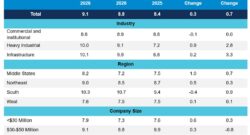
Associated Builders and Contractors (ABC) released its latest Construction Backlog Indicator in June, and the headline is pretty straightforward: work is still stacking up.In May, backlog rose to 9.1 months—up 0.3 months from April and 0.7 months compared to this time last year. That puts the industry near a three-year high, which signals steady demand across much of the country. Regionally, backlog increased everywhere except the South. Even so, the South still has the largest backlog overall and has seen the biggest year-over-year gains. For commercial paint contractors, that likely means continued opportunity in large-scale and ongoing projects, especially in consistently active markets. At the same time, ABC’s Construction Confidence Index readings for May showed a dip in expectations for sales, profit margins, and staffing. That said, all three metrics remain above 50, which means contractors generally expect growth over the next six months—but with a bit more caution than earlier this year. According to ABC Chief Economist Anirban Basu, much of the backlog growth is being driven by data center construction. Contractors working on those projects are reporting significantly longer backlogs—about 11.6 months compared to 8.6 months for those who aren’t. That surge is creating a bit of a split in the industry. Larger firms and those tied into major data center work are seeing stronger pipelines, while others may not be feeling the same momentum. That imbalance likely explains why confidence softened slightly, even as overall backlog increased. Bottom line: there’s still plenty of work out there, but where you sit—and what types of projects you’re tied into—matters more than ever right now.
Navigating the Minefield: Why Modern Labor Compliance Requires Precision
For decades, contractors have focused on what they do best: securing bids, managing supply chains, and ensuring quality craftsmanship. Today, a new operational challenge looms: navigating the complex, rapidly changing web of state and federal wage and hour laws. In this high-stakes environment, honest administrative errors can trigger devastating financial and legal penalties. Because crews move between job sites, handle varied shift lengths, and transition between differing tasks, relying on memory or manual tracking is no longer just inefficient; it is a massive liability. A Map of MandatesThe central trap of labor compliance is assuming that following basic federal rules keeps you safe at the local level. Whether your crews cross state lines or spend their entire 40 hours operating within a 20-mile radius, the United States functions under a patchwork of state-specific wage and hour regulations that aggressively override federal standards. On one end, states like Georgia and Wyoming default entirely to federal Fair Labor Standards Act (FLSA) guidelines, lacking mandates for daily overtime or rest breaks. On the other end, states enforce increasingly aggressive, hyper-specific labor laws. While California is famously strict where simple tracking oversights can snowball into 'million-dollar mistakes,' it isn't alone in enforcing rigid, localized parameters, according to BusyBusy1. Other states are also building aggressive frameworks:Oregon & Colorado: Enforce rigid daily overtime and meal/rest break mandates, heavily penalizing tracking gaps.Illinois & New York: Feature aggressive wage theft laws with massive, liquidated damages. Administrative mistakes can instantly double or triple penalties.Washington: Penalizes employers failing to track and pay for 'non-productive time,' like travel or morning safety meetings. The takeaway? Where your crew's work determines what the rules are, and “I didn’t know” isn’t a legal defense.The Cost of GuessingTo understand how quickly wage-and-hour laws can crush a construction business, you only need to look at a recent federal enforcement action in Nampa, Idaho. According to an official case report published by the U.S. Department of Labor (DOL) Wage and Hour Division, a residential contractor, Speedy's Framing LLC, was hit with a devastating penalty structure following a federal compliance audit. Investigators discovered the company fell into a classic recordkeeping trap, paying employees "straight time" rates for hours worked over 40 in a workweek instead of the federally mandated time-and-a-half premium. Even more telling was a tracking oversight involving a foreman who drove company vehicles between the shop and various worksites. Because this travel time wasn't properly logged and compensated, it resulted in compounding unpaid overtime violations2. The audit forced Speedy’s Framing to pay $293,698 in back wages to 56 affected employees, with individual payouts reaching as high as $32,047, plus an additional $24,795 civil penalty due to the willful nature of the tracking omissions2. The root failure wasn’t bad intent, just bad infrastructure. Without real-time, unalterable records across jobsites, Speedy’s couldn’t prove compliance even if they wanted to3. The company wasn't necessarily trying to intentionally cheat their crew; they simply lacked the unalterable, real-time records needed to maintain and prove absolute compliance across a mobile workforce. Choosing an AppWhen contractors realize the pitfalls of manual estimation, many adopt generic digital timecards. But standard "punch-in" apps aren't always built for job-site chaos. Many were built for employees who clock in at a desk, not for those spread across a handful of job sites.Construction-specific platforms do more than record time; they prompt workers to verify compliance with questions like "Did you take your break?" before they clock out. By capturing daily attestations, GPS, and travel, construction tech helps build an airtight defense that generic software cannot replicate. Adapting to Your StateBecause every jurisdiction maintains evolving standards regarding travel time, reimbursements, and shift differentials, knowing where to find authoritative information is key. The primary resource for local compliance is your state’s Department of Labor or Workforce Development agency. Additionally, associations and specialized labor compliance networks provide regional guides tailored explicitly to field trades. Ultimately, mitigating risk requires a fundamental shift in how time is viewed. Moving away from legacy systems to a dedicated, construction-specific platform turns accurate time tracking into a legal shield. By capturing exact start times, securing digital verifications at the point of tracking, and eliminating manual entry errors, contractors can protect their bottom line and focus on building projects rather than funding legal settlements. About the AuthorBracken Anderson is the Senior Partner Manager at BusyBusy. For more information, reach her at bracken.anderson@alignops.com. Sources referenced in this article: BusyBusy. (2025, October) How Wage & Hour Violations Turn into Costly Lawsuits U.S. Department of Labor (DOL). (2026, March 9). “US Department of Labor recovers more than $293K in back wages for 56 construction workers denied overtime by Idaho company.” (Press Release No. 26-359-SAN).HRMorning Employment Law Review. (2026, March 16). “Unpaid Overtime: Employer Pays $293K in Back Wages - Plus $24K Fine.” Case study evaluation on Speedy's Framing LLC internal control failuresBusyBusy Compliance Index. (2026). “Million-Dollar Mistakes: How California Contractors Can Avoid Costly Wage & Hour Penalties.” busybusy.com/blog/million-dollar-mistakes-how-california-contractors-can-avoid-costly-wage-hour-penalties/.

The 2026 CPIA Leadership Conference Is Going All-In on AI
The 2026 CPIA Leadership Conference is bringing one of the most practical and forward-thinking AI-focused programs ever assembled for the commercial painting industry. This is not a generic discussion about technology — it’s hands-on, contractor-focused education built to help companies improve operations, increase efficiency, strengthen profitability, and gain a real competitive advantage.Throughout the conference, attendees will experience AI-driven keynote presentations, contractor-led case studies, operational deep dives, and peer-to-peer discussions centered on how AI is actively transforming commercial painting businesses right now.One of the signature highlights of the conference will be a powerful Day 1 session led by Susan Frew, a dynamic entrepreneur, business strategist, AI innovator, and nationally recognized speaker known for helping companies bridge the gap between emerging technology and real-world business execution.Frew specializes in helping businesses eliminate operational inefficiencies, improve internal communication, automate repetitive tasks, and create scalable systems using practical AI tools. Her presentation is specifically designed for business owners and operational leaders who want to understand how AI can immediately impact estimating, scheduling, project management, communication, recruiting, documentation, workflow systems, and overall company productivity.Her high-energy, two-hour workshop will combine keynote-level inspiration with an interactive, hands-on working session that gives attendees actionable takeaways they can begin implementing immediately.Participants will learn how to:• Identify operational bottlenecks and areas of friction within their business• Utilize AI tools to improve efficiency and save time across departments• Streamline communication and internal processes• Create structured workflows and automation systems• Reduce administrative overload for leadership teams• Develop a practical 90-day AI implementation roadmap• Position their companies to stay competitive in a rapidly evolving marketplaceUnlike many AI presentations that remain conceptual or overly technical, Frew’s session is built around practical execution and measurable business outcomes. Attendees will leave with real strategies, real tools, and a clearer understanding of how AI can help their companies operate smarter — not just faster. Click here to register for the conference.

AI in Estimating
There is no universal roadmap for AI adoption. Different companies will do things… well, differently. And that’s A-OK. The important thing is that you don’t let the wildness of the AI frontier scare you.We've seen contractors moving quickly from curiosity to active implementation of AI estimating tools across the commercial painting industry. To help those who either haven't started or might be feeling stuck on their journey, we interviewed some contractors who have safely arrived on the other side to gain some insights, some findings, and some words of warning. Here are some key findings. (The full article appears in the most recent issue of Commercial Painting Magazine.)Right SoftwareChoosing the right software is one of the biggest hurdles that contractors face. A strong needs assessment, research, and considerations of current software were noted as important legwork when making this important decision.Service Contracting Solutions in Florida implemented Kreo in July 2025, after a full year of evaluating software options. The process began with a robust assessment—identifying the needs, wants, and goals of leadership and estimators.Some of the most important attributes identified by the team were the practicality of the system: how software handled interior and exterior surfaces, whether it could properly exclude windows and doors, the turnaround time per blueprint sheet, and overall accuracy. Those operational details ultimately mattered more than any of the flashy marketing language (which they found plenty of) around AI capabilities.For Magnum Drywall, Kreo also hit all their practical needs, but conflicts with another software already used in-house ultimately pushed them to BuzzBID because it integrated more naturally with its existing workflow and felt more familiar to users already accustomed to On-Screen Takeoff (OST).Right PeopleThroughout the process, SCS noted the importance of involving the right people and ensuring clear communication to avoid confusion and frustration. Overcoming the mental hurdles of change and allaying concerns of downsizing ensured estimators were motivated to make the change and gave them a voice in choosing a software they would actually use.Instead of executives making a top-down technology decision, they intentionally placed estimators at the center of testing and selection.Even for those not centrally involved in the new technology, the company keeps open communication about technology decisions, focusing on explaining why changes were being made and explaining how the technology creates opportunities instead of eliminating roles. They even set aside time to listen to concerns so that solutions can be found together.Peer CollaborationFor Magnum, peer collaboration also played a huge role in their selection process. After SCS completed its Kreo implementation, the company openly shared lessons learned and even hosted demonstrations to help Magnum speed up its evaluation process.That willingness to share operational knowledge reflected a broader culture within the commercial painting industry—and particularly within the CPIA network—where contractors often help one another navigate emerging technologies rather than treating every process as proprietary.Words of WarningThough both contractors reported success with their adoption, they also warned of complications that required attention.Vendor claims. Contractors noted that many platforms marketed as “AI estimating software” contain only limited AI functionality. Before purchase, get your expectations in check, do thorough research, and don't forget reference checks.Training. This is not an out-of-the-box solution. AI requires a lot of training and refinement to teach the software how you estimate, communicate, and organize.Know Your Stack. As Magnum found out, not everyone plays together. Ensure that you have checked and double-checked that the new software doesn't conflict with what you already have in-house.Even though the processes were different, one thing was clear — AI estimating is no longer a distant concept. Contractors are actively testing it, refining it, and integrating it into real-world operations right now. Those who approach implementation strategically may gain significant advantages in speed, efficiency, and scalability moving forward.Want to read the whole article? Read A View From the Frontier in our latest issue.Want to learn more about shopping and troubleshooting AI estimating software from the people who have actually implemented it? Join us at the CPIA Leadership Conference in September for panel discussions and peer-to-peer conversations on the topic. Register today.

Paint Isn't Boring
Craig Bundren is a third-generation painting contractor out of Houston, Texas. He sat down with Emily Howard to talk about what he loves about being a painting contractor, how he is empowering his staff to embrace technology, and why he values his CPIA peer group. Emily Howard: Tell me a little bit about Bundren PaintingCraig Bundren: We've been in business since 1984. I am a third-generation painting contractor and took over in 2011. When my dad started this business, he started doing Home Depot’s, then as we progressed through the years, it's been a mixed bag depending on what the economy is doing.Right now, we’re mainly focused on hospitals, higher education, and multi-family high-rise buildings. Whatever the next big thing that comes out, I'm sure we'll end up doing. EH: What are some of your favorite projects?CB: There are so many. A lot of people think paint is boring. You know the saying about watching paint dry, but I’ve always found it so interesting. I have gone so many places that I never would have been able to go had I not been in this business. I’ve stood in the basement of the Federal Reserve building in downtown Houston with pallets of cash and guys with AR 15s. I've been in battleships and in a bomb shelter downtown.We did some work in the Houston Medical Center after some flooding, and I walked by labs with doors closed and a red warning marked anthrax. So, it's I've gotten to see some really cool things.I’ve always liked the hospital projects because you're working towards something that helps the community.Overall, I think my biggest excitement is when we can use a different product to solve a problem or figure out a better option to access a tough area. Figuring out the tough projects is cool. EH: How have you embraced change over your time running Bundren Painting? CB: I have always been one of those people who want to be on the cutting edge of everything. Coating solutions like self-cleaning paint and odorless coatings are great innovations, and staying on top of those innovations has been a great way to get in the door for projects. We show that we can really solve problems with the right coating.Technology has changed a lot, too. I remember several years ago, our office flooded twice in a very short period of time. Our IT person actually rebuilt our computer system and ran it out of his garage. That allowed me to have my team members work off-site while we rebuilt the office from the flood.Because of that, when COVID hit, we were fully set up to work from home. We thought we were just on top of the world because we had everything.Today, changes seem to be coming more quickly, especially in technology. Sometimes it feels like there's no way to get on top of it. I believe that we're on top of it, but it's a lot to keep up with. EH: Looking into 2026, what challenges are you preparing for? CB: I’m aware that you never know what you could potentially have to prepare for. There are so many unknown unknowns. The world has been really strange since COVID.As a business, I’m focused on my numbers and making sure we get enough to feed the machine while ensuring we stay on top of technological advances. I’m asking, “How are we estimating? Should we bring AI into estimating? Should we bring AI into our finances?” I think AI is the thing touching everything, so there is a lot to look forward to.But things are changing so fast that I, as a business owner, can't always keep up with it. In the past, you would say, " Oh, these robots are new. Cool, I'll go look into them.” But there are so many new things coming out, you really have to delegate.Right now, I’m asking department heads to look at specific things and tell me if they think it will help them. I’m always asking what's going to improve their experience or make things easier?We talk a lot about what technology others are exploring in my peer group, and everyone mentions things that others haven’t heard of. EH: Speaking of peer groups, how did you get involved with the CPIA? CB: You know, I came to the first Leadership Conference. Once I got to meet the other people and spent some time with Aaron, I was like, I’m in! It was like what they say about Texas, I wasn't born here, but I got here as fast as I could.The peer groups are so beneficial because you can get your questions answered. Just last week, I sent something to my peer group about how insurance is killing me and asked what they were doing about it. From that email, I got so many replies sharing experiences and things they have tried.The other really cool thing is that a lot of our conversations end up on personal things that we are going through. If you are having a problem, business-wise or familywise, other people in the group have likely experienced it too and share how they got through it. It's people who really care.Being in a position running a business, you can feel alienated. It’s good to have people to talk to. Looking to join a CPIA peer group? Learn more here.
Maryland PaintCare Program Becomes 13th State-Wide Paint Recycling Program
Contractors, households, and businesses in Maryland can now recycle their leftover paint with PaintCare! PaintCare is a nonprofit organization that plans and operates paint stewardship programs in states and jurisdictions that have passed the paint stewardship law. The Maryland PaintCare program launched on April 1, 2026, making it the thirteenth jurisdiction to pass paint stewardship legislation. With the addition of Maryland, PaintCare now serves one-third of the U.S. population. PaintCare operates a network of over 100 drop-off sites across the state where contractors, households, and businesses can recycle their leftover paint at no additional cost. Most drop-off sites are located at local paint retailers, making it convenient for Marylanders to properly dispose of their leftover paint. To find a drop-off site near you, visit the drop-off site locator on PaintCare’s website. Painting contractors are encouraged to utilize the PaintCare program. PaintCare offers a large volume pickup (LVP) service, which provides free pickups of 100 gallons or more of eligible paint products. Painting contractors can use this service to responsibly dispose of leftover paint that has been accumulated from previous jobs. Large volume pickups can be requested through the large volume pickup request form. The paint stewardship law requires a fee, called the PaintCare fee, to be added to the purchase price of new paint. The fee is based on container size and funds all aspects of the program. This includes paint collection and recycling, consumer education, and program administration. Painting contractors are encouraged to keep this fee in mind when preparing quotes and to pass the fee to their customers, ensuring a level playing field for everyone who uses paint. The PaintCare fee in Maryland is as follows:Container SizeFee AmountHalf pint or smaller$0.00Larger than half pint up to smaller than 1 gallon$0.501 gallon up to 2 gallons$1.15Larger than 2 gallons up to 5 gallons$2.25 To learn more about PaintCare and the Maryland PaintCare program, please visit www.paintcare.org or reach out to PaintCare at info@paint.org. PaintCare Inc., a non-profit organization, continues to expand its reach through partnerships with organizations, including CPIA. PaintCare sets up drop-off locations for leftover paint, arranges for recycling and proper disposal, and conducts public education. More than 88 million gallons of architectural paint products have been managed by PaintCare in 12 states and the District of Columbia. Together, painting contractors have convenient ways to dispose of leftover paint, keeping it out of the waste stream and out of their storage spaces.